
The Art of Building: Oficina Marques
One idea runs throughout the work of Oficina Marques: the desire to explore the boundaries between art, craft, design and architecture. Founded by Gezo Marques and José Aparício Gonçalves, the studio has developed a visual universe defined by relief, materiality and a strong connection to the natural world. With the Arcádia collection, created in collaboration with Viúva Lamego, this universe takes on a new scale, finding its place in a variety of settings, from residential and commercial interiors to workplaces.
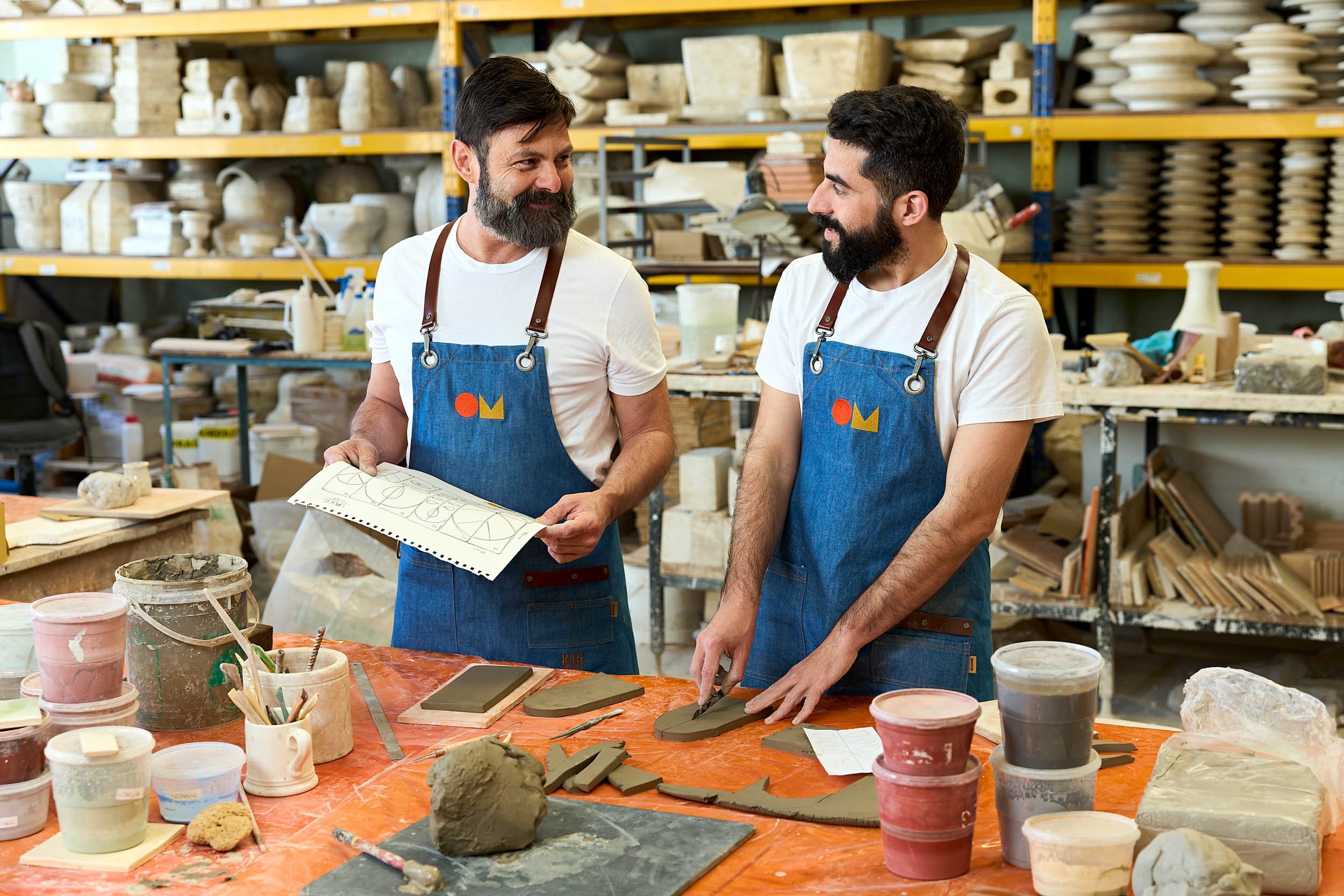
Gezo Marques and José Aparício Gonçalves during the creative process behind the Arcádia collection, created in collaboration with Viúva Lamego
This project also grew out of a collaboration with Viúva Lamego, for which the duo created two panels for an exhibition celebrating the historic Portuguese brand’s 175th anniversary at the National Tile Museum. An artistic residency at the Viúva Lamego factory gave Gezo Marques and José Aparício Gonçalves the opportunity to explore the brand’s heritage and learn from its artisans, laying the foundations for a collaboration that would eventually take shape in the Arcádia collection.
The master tiles were handcrafted by Oficina Marques and subsequently used to create the moulds for the collection’s production. This process reflects one of the duo’s ambitions: to take their artistic language and hands-on approach to making beyond their usual boundaries. “Our aim was to bring Oficina Marques’ art and craftsmanship to an architectural scale, introducing our universe into other projects with a larger spatial footprint and exploring other dimensions of the human experience,” explains Gezo Marques.

Detail of a tile from the Arcádia collection
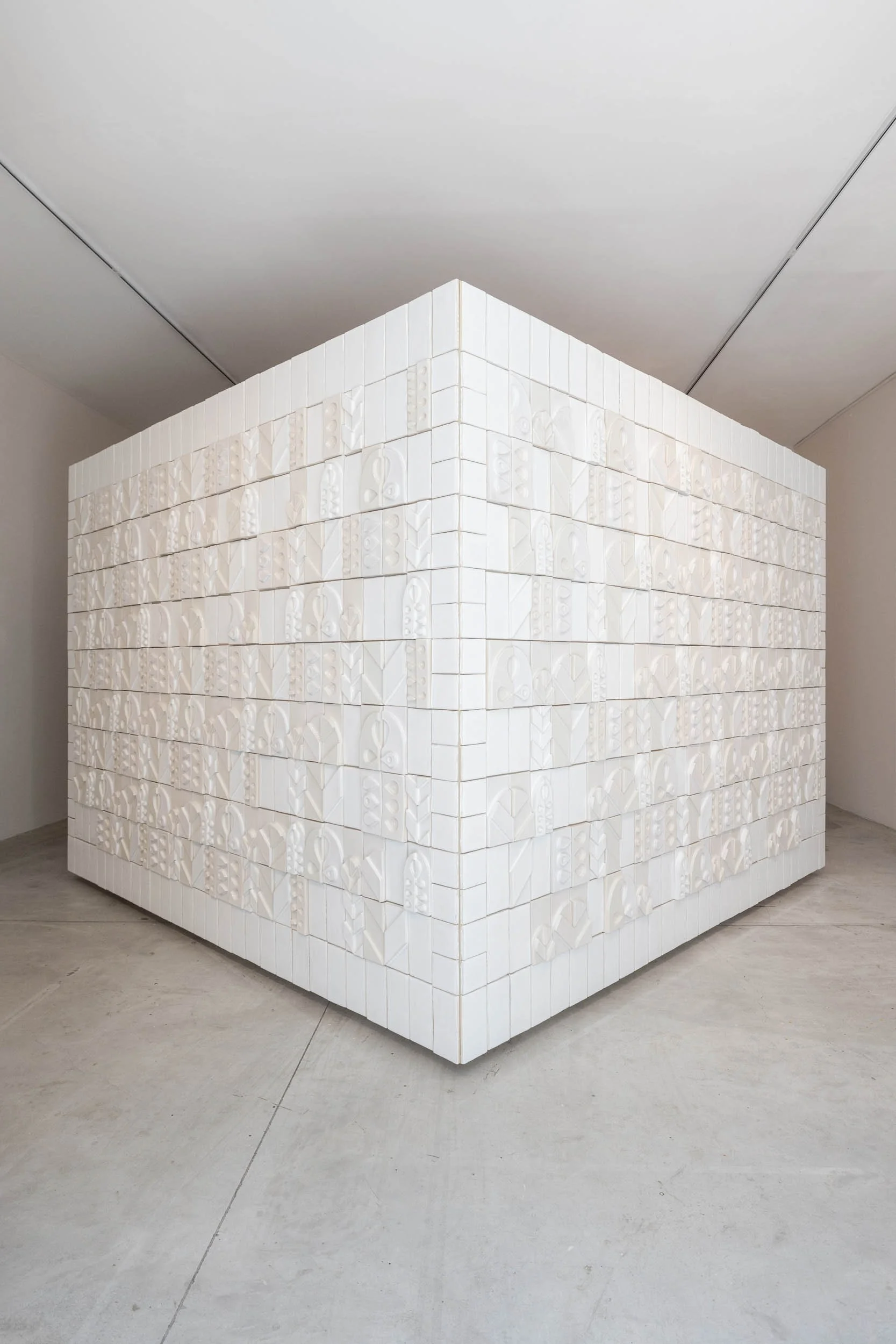
Installation of the Arcádia collection at Oficina Marques’ gallery during Lisbon Design Week 2025, created in collaboration with Spacegram
When Art Enters the Workplace
The presence of Arcádia in AstraZeneca’s new offices demonstrates precisely how the collection can adapt to a larger architectural scale. Built by Vector Mais, the project spans six floors of the Báltico Building in Parque das Nações, Lisbon, bringing together around 750 employees in a new flagship hub for the company.
Conceived by Gensler and delivered through a design-and-build process by CBRE | Turner & Townsend, the space seeks to establish a direct connection with the city and Portuguese culture. Materials, colours, textures, natural elements and works of art come together in an architectural setting designed to create distinct experiences across the different floors.
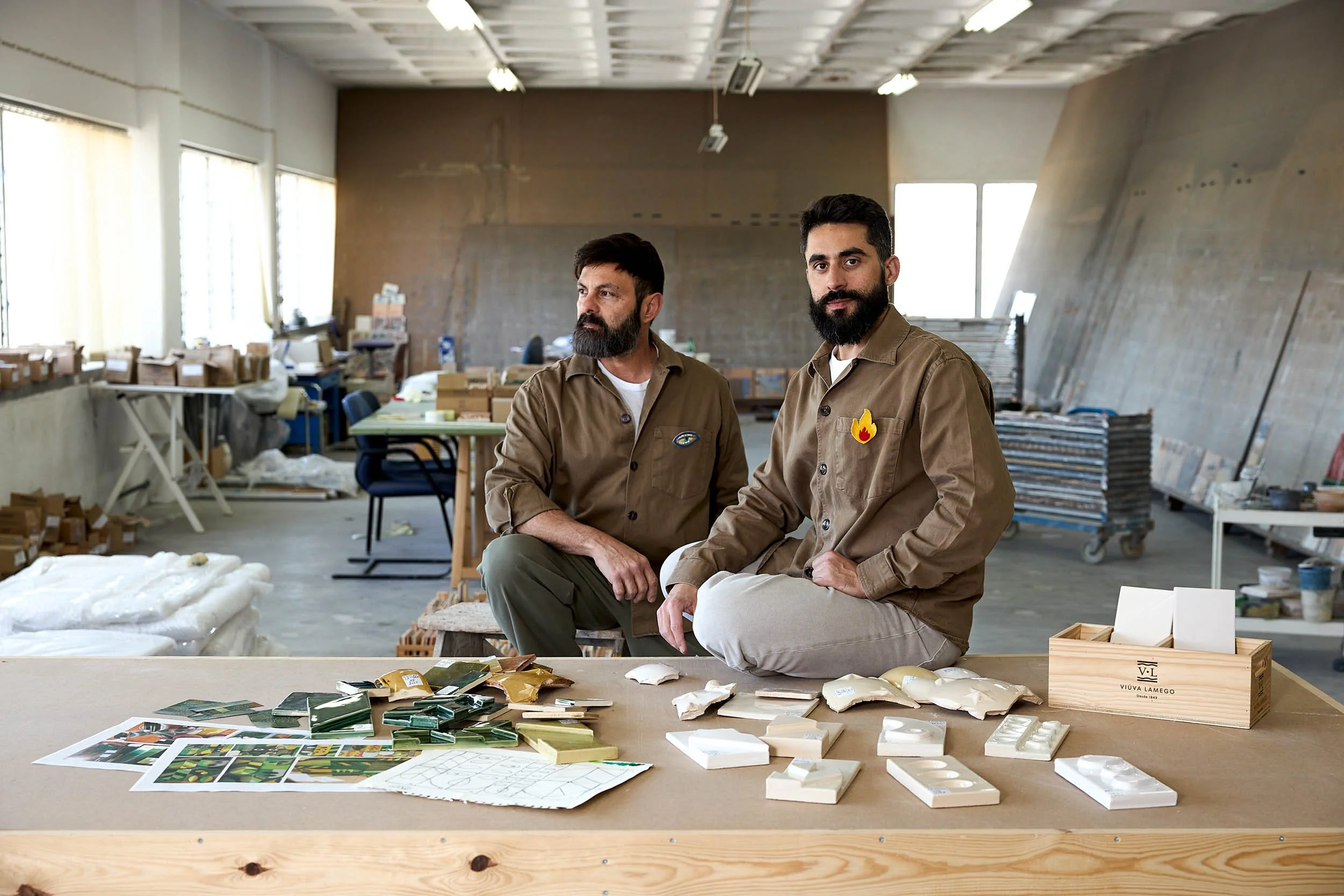
Gezo Marques and José Aparício Gonçalves, the duo behind Oficina Marques
In this context, Arcádia introduces a dimension deeply rooted in materiality and craftsmanship. The tiles’ reliefs bring depth to surfaces, introducing a nature-inspired visual language into the corporate environment and challenging the conventional notion of an office as a purely functional space.
This choice takes on added significance when we consider how much time people now spend at work. For Oficina Marques, bringing the collection into these environments represents an opportunity to make the spaces that shape so much of our daily lives feel more welcoming and easier to inhabit. “So much of people’s lives today revolves around these places, where they spend a large part of their time. It makes us very happy to think that, through our work, we can help make these spaces easier to inhabit,” adds José Aparício Gonçalves.
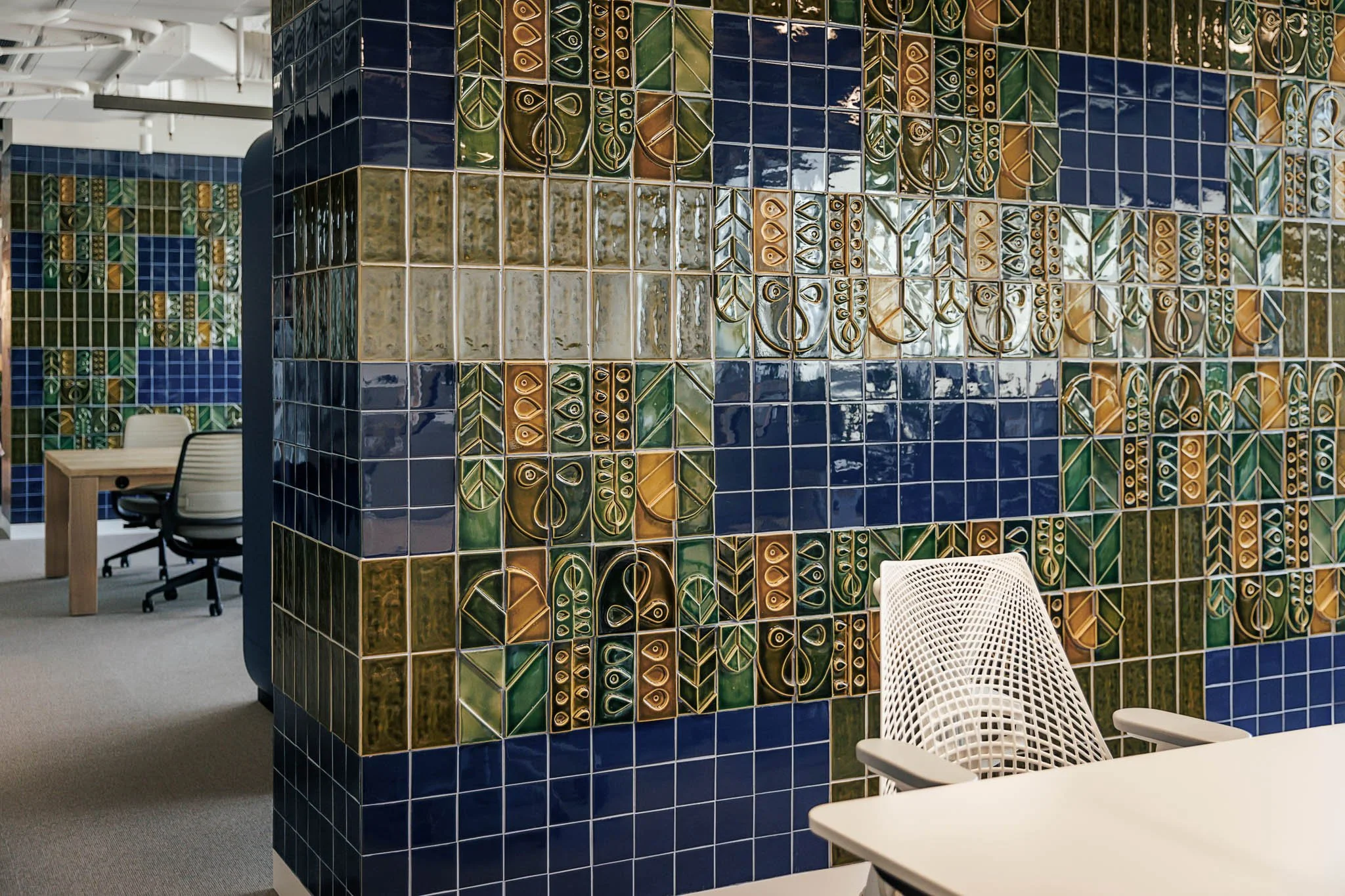
Arcádia tiles in AstraZeneca’s offices
“From the very beginning, we imagined Arcádia in any setting, and an office like AstraZeneca’s was undoubtedly an excellent setting for our collection.” — José Aparício Gonçalves
Between Tradition and Contemporaneity
Arcádia also offers a reinterpretation of Portuguese tiles. By bringing together Oficina Marques’ contemporary language and Viúva Lamego’s expertise and tradition, the collection demonstrates how a material deeply rooted in Portuguese culture continues to find new possibilities in contemporary architecture. Rather than simply reviving a technique that forms part of Portugal’s heritage, it brings it into dialogue with new forms of creation and use. The tile moves beyond its traditional role as a surface covering to take on a sculptural, tactile and expressive dimension.
This approach lies at the heart of Oficina Marques’ practice. “We are always exploring the boundaries between disciplines and value interdisciplinary dialogue.”
This desire to bring different worlds together runs throughout Arcádia, from its conception to its application in real projects. The collection emerged from an artistic practice, was developed in collaboration with one of Portugal’s leading names in ceramics, and now finds its place in environments where architecture and everyday life intersect.
At AstraZeneca’s offices, this journey becomes particularly evident. A visual language developed in the studio becomes part of a large-scale architectural project, helping to shape a contemporary workplace that remains deeply connected to its cultural context.
From the hand-crafted master tile to the architectural surface, Arcádia demonstrates how art can expand into new dimensions without losing its essence. It also shows how, through architecture, Oficina Marques’ work can reach people in new ways and become part of their everyday lives.

Arcádia